
We are pleased to share that the new 2026 Data Management and Sharing Plan (DMSP) format for NIH is now available in the DMP Tool. While this form is not required for applications until May 25th, NIH has stated that they are already accepting it and encourage people writing new plans to use the new format.
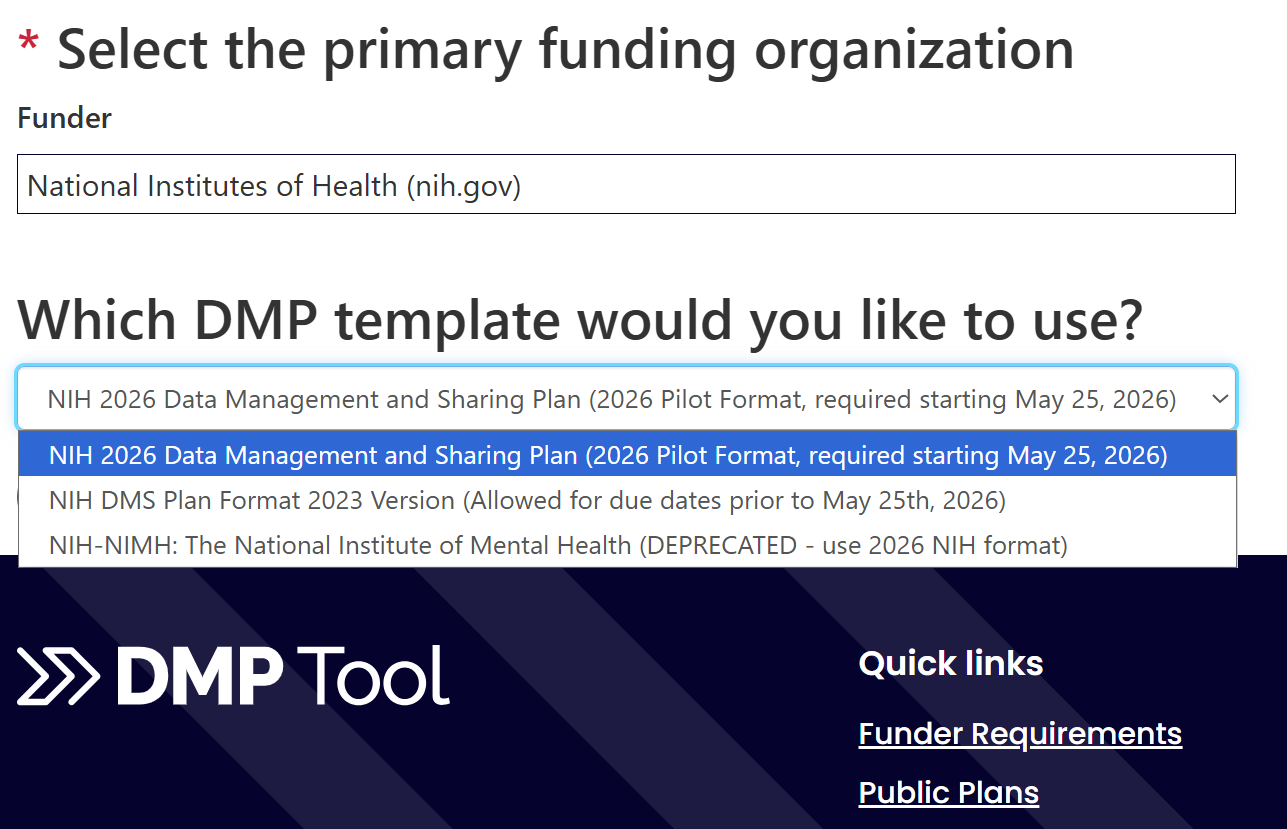
The new template in the tool is currently titled “NIH 2026 Data Management and Sharing Plan (2026 Pilot Format, required starting May 25, 2026).” The 2023 version (formerly known as NIH-Default DMSP) is still available in the tool as well for now with the new title “NIH DMS Plan Format 2023 Version (Allowed for due dates prior to May 25th, 2026)”, as it is allowed prior to May 25th. However, the 2026 template is the recommended format now and will be the first result returned when users select NIH as their funder.
The legacy NIH-NIMH template is also being deprecated because the new 2026 NIH DMSP format applies across all NIH Institutes and Centers, including NIMH. On May 25th, the older NIH templates will be marked deprecated and then removed, leaving the 2026 format as the single NIH template option that applies to all NIH applications (though some Institutes may have additional sharing policies to keep in mind when answering the questions). We will update the title of the 2026 format at that time to remove the May 25th date.
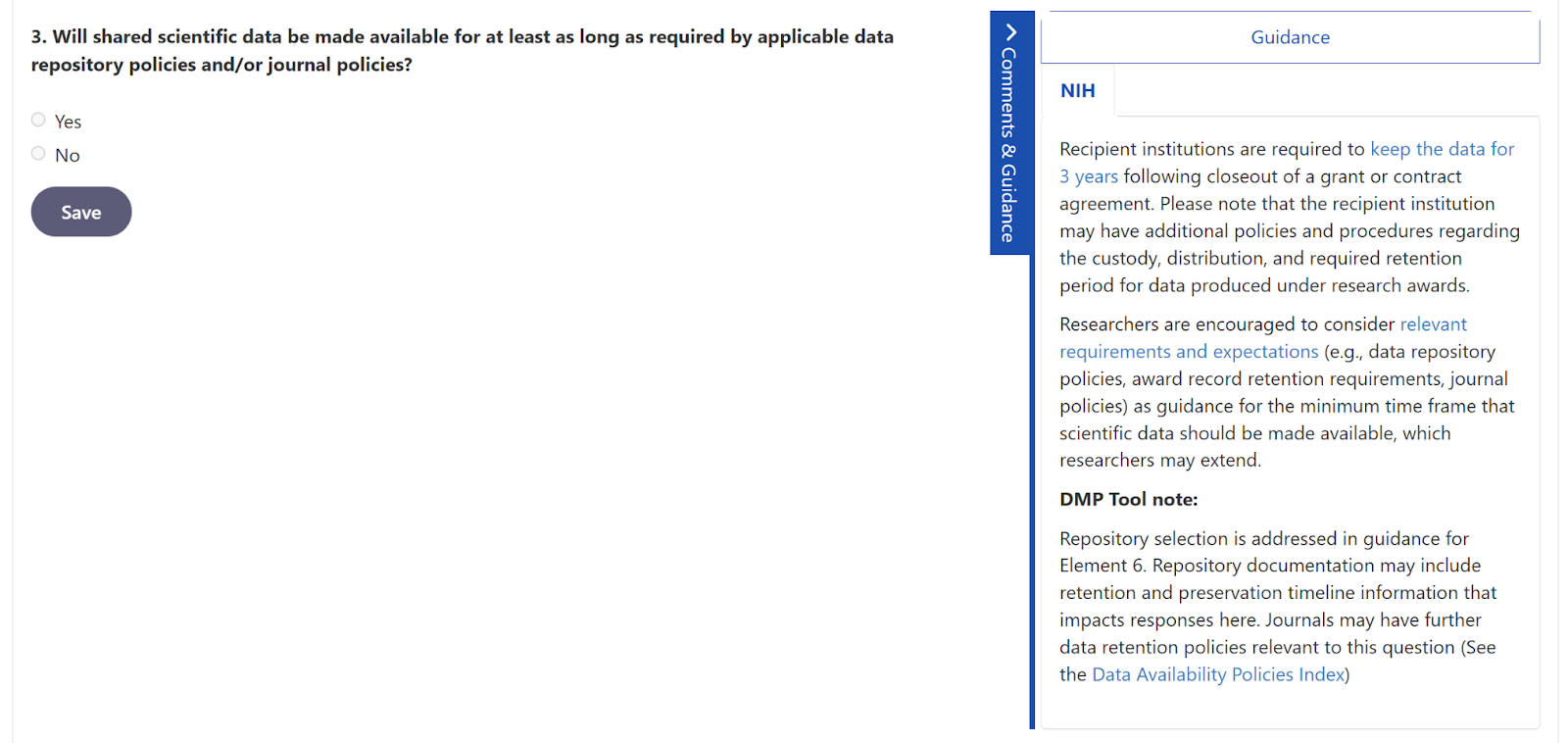
The template matches the NIH Format as closely as possible and brings in relevant Guidance from NIH policies, help pages, and FAQs to help researchers answer each question appropriately. It also includes sample responses for elements such as Element 4 and Element 6 to help users better understand type of information NIH is expecting.
You can download a copy of the template or start a plan from it at our Funder Requirements page.
NIH DMSP Template Working Group
To curate the guidance, the NIH DMSP Template Working Group, who developed the guidance for the 2023 template in the tool, came back together to work on adding new guidance from this updated form. The group was again chaired by DMP Tool editorial board member Nina Exner and involved the following members who contributed to meetings and guidance additions:
- Nina Exner (Chair; DMP Tool Editorial Board Member), Virginia Commonwealth University
- Mathew Covey, The Rockefeller University
- Will Dean, Temple University
- Seonyoung Kim, Washington University in St. Louis, Bernard Becker Medical Library
- Jim Martin, University of Arizona
- Genevieve Milliken, University of Nevada, Las Vegas
- Melissa Ratajeski (DMP Tool Editorial Board member), University of Pittsburgh
- Lesley Skalla, Duke University Medical Center
- Amy Yarnell, University of Maryland, Baltimore
Each question has guidance pulled from various NIH policy pages and FAQs to give information on how to answer each question. There are occasional notes about the tool implementation as well. The group’s goal was to balance giving enough guidance to bring key points right into the tool, but not overwhelming with too much text, so there is a mix of both direct guidance and links to other pages that may give more detailed information.
We at UC3 want to thank all of these members for their work to help get this out in a helpful and timely manner for NIH applicants. Navigating the policy documents and resources to bring the concise but comprehensive guidance to each question took a lot of effort from all members, and we are grateful to their work for making these templates accessible to plan writers.
Additional DMP Tool notes for Administrators
- Any plans created under the old templates will be unchanged, even once those templates are removed later. Template updates only impact new plans created after the publication of a template or update.
- If you would like to add customizations to the NIH 2026 template for your organization, such as additional institutional questions or extra guidance for researchers at your university, see our documentation on customization.
- If you added customizations to the 2023 NIH-Default DMSP template, they will not roll over to the 2026 template (since it is a brand new template and not just a version update), and your content will become inaccessible in the admin menu once the 2023 template is unpublished. Please download or copy anything you want from your customization before the end of May 2026.
- If your institution previously added custom guidance to the legacy NIH-NIMH template, please review and migrate that content to the new 2026 NIH template. Since the 2026 NIH DMS Plan format now applies across all NIH Institutes and Centers, including NIMH, the older NIMH template should no longer be used for new plans and can be removed after your guidance has been transferred. Please download or copy anything you want from your customization before the end of May 2026.
- If you have any issues or questions around the new template, please reach out to us at dmptool@ucop.edu.
Other resources on the NIH form
- NIH DMS Plan Format Updates, 2026 Edition: What to Know
- NIH OPERA’s Additional Clarifications on the 2026 DMSP Format
- Mapping the original Elements to the new Elements
Thank you once again to the working group and everyone who has written guidance to help navigate this new update! We’ll continue to monitor changes and updates from NIH to reflect the most up to date format and guidance.
Notice: In a future post, we will discuss updates related to NSF templates releasing next week. Our plan is still to mirror them from Research.gov as best we can once we can view them in the tool. For more on UC3’s thoughts on these changes, see our article What is the Future of Data Management Plans? on the Upstream blog.


You must be logged in to post a comment.