
Set the controls for the heart of the sun

Our DMPTool and DMPonline services have been humming along with the same underlying code for a couple of months now. Since our MVP release, we’ve shifted gears to more regular sprints. We’re also pleasantly surprised by how eager the wider DMP community has been to join forces in migrating, translating, and even contributing new features already! Here’s a brief retrospective and a glimpse into the future.

Post MVP Backlog
There is a modest backlog of work that didn’t make into the MVP release. We’ve prioritized these issues and are focused on tying up the loose ends over the coming months. Those following the DMPRoadmap Github repository will notice regular releases. The goal is to settle into a steady two-week rhythm, but in the near term we’re working on slightly shorter or longer cycles to address critical bugs and some minor refactoring. Many thanks to our users on both sides of the pond who have reported issues and provided overwhelmingly positive feedback so far!

Evolving processes
We’ve been communicating with our respective user communities about new fixes and features as things pertain to them. Some things to note about our evolving development process:

  • DMPRoadmap GitHub repo: this is where most development work happens since the majority of fixes and features apply to the core codebase. This repository also contains all technical documentation, release notes, and other info for those interested in deploying their own instances or contributing to the project.
  • The DMPRoadmap wiki has a list of potential future enhancements. We’re collating ideas here and will define priorities and requirements in consultation with the community via user groups and listserv discussions. If you have other desired new features please let us know.
  • Any service-specific customizations reside in separate GitHub repos. For example, you can find the custom Single-Sign-On code in the DMPTool GitHub repo. The way that we handle helpdesk functions varies too. DMPTool users can report issues directly in the DMPTool repo or via the helpdesk. If something pertains to the common codebase, Stephanie will tag the issue and transfer it to DMPRoadmap. For DMPonline users we ask you to report issues via the helpdesk.

External contributions
Our core dev team is test driving the external contributor guidelines with the French team from DMP OPIDoR. They developed a new feature for a global notification system (e.g., to display maintenance messages, updates to funder templates) that happens to be in our backlog. The new feature looks great and is exactly the kind of contribution we’d like from others. You’ll see it in the next release. Thanks Benjamin and Quentin!

We’re also keen to commence monthly community dev calls to learn about other new features that folks might be planning and keep track of how we collaborate on DMP support across the globe.

Translations
We’ll be adding new translations for Brazilian Portuguese (thanks to Benilton de Sá Carvalho and colleagues at UNICAMP) and Finnish thanks to DMPTuuli. We’re also reaching out to fill in missing portions of existing translations for other languages since we added so many new features. New translations are always welcome; more information is available on the GitHub wiki and/or contact us.

A machine-actionable future
With the launch milestone behind us, we’re devoting more attention and resources to creating a machine-actionable future for DMPs. Two working groups hosted productive sessions at the recent RDA plenary (DMP Common Standards, Exposing DMPs) that included lightning talk presentations by members of the DMPRoadmap project (slides 1 and slides 2). Both of the groups are on track to provide actionable outputs in the next 12 months that will bolster wider community efforts on this front. We’ll continue participating in both groups as well as begin prototyping things with the NSF EAGER grant awarded to the California Digital Library. Stay tuned for more details via future updates and check out the activedmps.org site to get involved.
Templates and guidance 101

We’ve been running the new DMPTool for about a month now and are gratified by the positive reception from all corners of the globe. Now that we’re settling into a regular development rhythm and tying up some loose ends, I want to circle back to the topic of templates and guidance for organizational administrators.

DMPTool data migration adverse effects

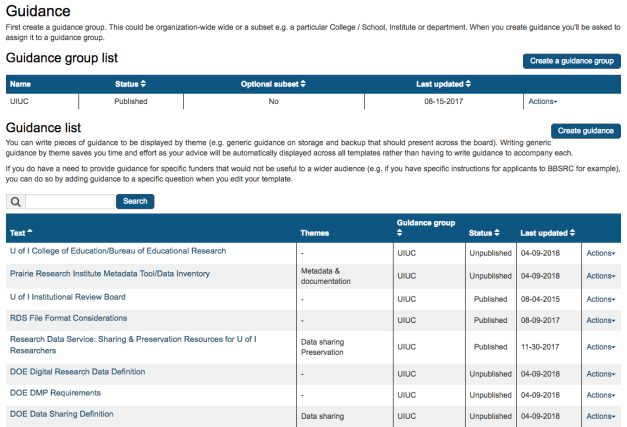
As I mentioned in a recent message to the admin listserv, you may notice some misplaced organizational guidance as a result of migrating data from the old version to the new data model. Some pieces of guidance (e.g. text, links, example answers) that were created by an organizational admin and attached to specific templates (e.g. NIH Genomic Data Sharing) became divorced from the template and now appear in the list of generic themed guidance. This resulted in some cases where users now see e.g., information about NIH genomic data repositories as part of their local/organizational guidance regardless of the template they selected.

UIUC misplaced guidance

Note the DOE guidance links are “Unpublished.” These should be transferred to the DOE templates as customizations.

We’ve evaluated the extent of the problem, which can’t be solved programmatically (alas!)—there are about 30 published (active) organizational templates owned by various universities and about 40 universities who created pieces of guidance for specific funder templates that may no longer be attached to the appropriate template. We’re asking for your assistance to implement the following solution:

  1. Please take a look at your organizational Guidance in the Admin menu (screenshot above) and identify anything that seems out of place.
  2. If you can determine which template a particular piece of guidance should be attached to, you should transfer it to the appropriate question(s) for the appropriate template in the Templates menu by creating a “customization” (instructions in the Help for administrators > Customizing funder templates).
  3. After you create the customization, go back to the Guidance area and remove that piece of guidance. Alternatively, you can just unpublish the pieces of guidance that should not appear as generic guidance on all templates (instructions for Creating guidance).
  4. If you can’t easily determine where any misplaced guidance should go, contact us and we can assist you. Please just be patient with turn around times as *we* are a team of two with many other duties to juggle.
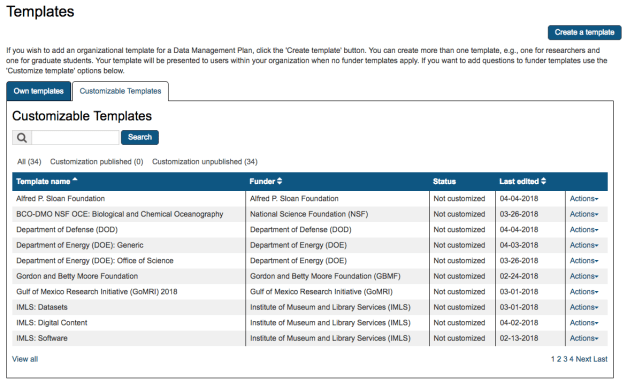
DMPTool Templates menu

Templates menu: this is where admins can create your own institutional templates or customize funder templates.

Create themed guidance

This is also a great time to familiarize yourself with the new concept of themes and apply them to your organizational guidance. Themes represent the most common topics addressed in data management plans and work like tags to associate questions and guidance. Questions within templates can be tagged with one or more themes, and guidance can be written by theme to allow organizations to apply their advice over multiple templates at once.

Here is a partial inventory of funder template themes (full inventory coming soon) to guide your tagging efforts. You will notice that some of your guidance has already been tagged with one or more themes—we applied these programmatically during the data migration using keywords. You should evaluate the themes and make any desired changes, as well as verifying that all of your guidance is accurate and up to date. In the first screenshot above, for instance, the guidance links that have no themes will not be displayed to end users.

Admin webinar for templates and guidance

I will host a webinar focused on organizational templates and guidance topics sometime in May (TBD soon). In the interim please contact us with specific issues, questions, etc. that you would like to see covered in more detail.

And of course continue to report bugs, request enhancements, and/or tell us how much you like the new interface via GitHub Issues or the contact form.

Get your DMPTool stickers and postcards!

One last reminder that new marketing materials are in the works and scheduled to ship in May. Place your orders now!

We have lift off – DMPRoadmap launches!

fireworks

From Flickr by bbtburnham http://bit.ly/2FmYLIE

by Sarah Jones

We’re delighted to announce that the DMPTool and DMPonline sites are both now running from the new joint DMPRoadmap codebase. We pushed the MVP out to test last month and have now migrated our production services. There are lots of exciting new features (v1.0 release notes).

The site will undergo a second round of accessibility testing soon and we’ve done a number of performance and usability improvements as part of bringing together our two codebases. We have also implemented the revised set of DMP themes agreed with community input last year. For UK users this means legacy guidance for removed themes has been merged and will need editing. See more information in this news item.

We gave a demo of the new system at the IDCC conference in Barcelona last month, and also gave a paper on a landscape analysis of “Active DMPs,” charting all the work that is going on in this area internationally. This information is available on a new website http://activedmps.org to serve as a central hub of machine-actionable DMP work. We invite everyone to update the site with links to any requirements you collect, or details of new tools emerging in this area. And don’t forget to join the sessions at the next RDA plenary where the DMP Common Standards WG will be comparing data models for the different DMP tools and the Exposing DMPs WG will be defining which elements of DMPs need to be shared to which actors. We also have a paper forthcoming that touches on work in these areas: the pre-print of 10 Simple Rules for Machine-Actionable DMPs is out now in Zenodo.

There is a huge number of users of the DMPRoadmap codebase. In addition to the core DMPonline and DMPTool services, there are many other instances internationally, some hosted by the DCC, but the majority are run by external groups. We estimate 50k+ users, 400+ participating institutions internationally and a growing list of funder contacts across the globe. We encourage those hosting their own instances to migrate from the former DMPonline v4 code to DMPRoadmap, and to continue to contribute back to the joint development effort like the Portage consortium in Canada and DMP OPIDoR in France have done. Migration guidelines are available to help dev teams make the switch and we have a Slack channel for external contributors. If you aren’t already a member, join here.

As always we welcome your feedback and look forward to continuing to improve the DMP experience for everyone involved in the research enterprise.

New DMPTool launched today!

dmptool logoWe’re delighted to announce a successful launch of DMPTool version 3 today. This milestone represents the convergence of the two most popular data management planning tools—US-based DMPTool and UK-based DMPonline—into a single, internationalized platform. We plan to bring the many other installations of the tool in Canada, Australia, South Africa, Argentina, and throughout Europe along for the ride as we work together to make DMPs a more useful exercise for everyone!

Currently the DMPTool supports 226 institutions and more than 28,000 users worldwide. The new DMPTool retains all of the existing functionality plus some handy new things, all in a shiny new package:

For everyone

For organizational administrators

  • New administrator help guide
  • Updated resources for promoting the DMPTool coming soon (stickers, postcards, and slide decks). Order new promo materials using the form below.
  • Institutional branding in the main banner (upload a new logo, provide contact information)
  • Create themed guidance that can be applied across all templates
  • A usage dashboard and report of plans created by users at your organization
  • Ability to view guidance and templates created by other organizations

Order form for new stickers and postcards – we’ll ship materials in early May 2018

Please report any issues or enhancement requests via GitHub Issues. Or you can always contact us directly! If you notice anything amiss with your existing plans and/or templates, let us know and we will fix it in short order.

Prepare for launch in 3… 2… 1…

In about two weeks we will launch the new DMPTool on Tues, 27 Feb. The much-anticipated third version of the tool represents an exciting next step in what has always been a community-driven project. We’ve now successfully merged the primary US- and UK-based data management planning tools into a single codebase (DMP Roadmap): the engine under the new DMPTool hood.

Why are we doing this?

A little background for those who haven’t been following along with our codevelopment journey: in 2016 the University of California Curation Center (UC3) decided to join forces with the Digital Curation Centre (DCC) to maintain a single open-source platform for DMPs. We took this action to extend our reach beyond national boundaries and move best practices forward, with a lofty goal to begin making DMPs machine actionable (i.e., useful for managing data). We’ll continue to run our own branded services (DMPTool, DMPonline, DMPTuuli, DMPMelbourne) on the shared codebase, and incorporate partners in Canada, Argentina, South Africa, and throughout Europe who are already running their own instances (full list).

In parallel with our co-development efforts we’ve been making the rounds of Research Data Alliance, Force11, IDCC, and disciplinary meetings to collect use cases for machine-actionable DMPs (details here) and help define common standards (RDA Working Group; just posted pre-print for 10 Simple Rules for Machine-Actionable DMPs). We also got an NSF EAGER grant so we can begin prototyping muy pronto.

The new version of the DMPTool will enable us to implement and test machine-actionable things in a truly global open science ecosystem. Successful approaches to making DMPs a more useful exercise will require input from and adoption by many stakeholders so we look forward to working with our existing DMP Roadmap community (an estimated 50k+ users, 400+ participating institutions, and a growing list of funder contacts across the globe) and welcoming others into the fold!

Preparing for Launch

To help DMPTool administrators prepare themselves and their institutional users for the upcoming launch, we will host a webinar on:

Mon, 26 Feb 2018, 9-10 AM Pacific Time
Zoom link (recording on Vimeo; Q&A and slides)

By that time we’ll have a new user guide for administrators, a new Quick Start Guide for researchers, and refreshed promo materials. Everyone will have seamless access to their existing DMPTool accounts, just through a new user interface that looks and feels more like DMPonline (spoiler alert: we made it blue). And one of the most exciting things about the new tool is that it contains 34 freshly updated funder templates with links to additional funder guidance.

Stay tuned to the DMPTool communication channels in the coming weeks (blog, admin email list, Twitter) for more news and updates. We look forward to seeing you at the webinar and welcome your feedback at any point.
