DMPTool2 Project — July 2013 Report

Overview

While technical developments are still underway and on-time, much of the past month’s focus has been on outreach efforts. Not only has the outreach team achieved their objectives for the month, but they have also developed several initiatives that impact the project and its trajectory in positive ways.

Technical Team

In the last month, the technical team has completed all Phase One stages of their development schedule. With all login functionality pieces in place, the team is prepared to begin Phase Two—implementing all remaining functions of the tool, with an estimated completion at the end of September. Meanwhile, user interface (UI) design is underway. Site wireframes are undergoing a second round of review, with a more aesthetic focus. The technical team is collaborating with several others on such design decisions as branding and outsourcing. The team has engaged in continued talks with the Center for Open Science (COS) regarding implementing DMPTool into Open Science Framework. A similar opportunity has arisen with the Gulf of Mexico Research Initiative, who have expressed interest in implementing DMPTool in a similar way. Discussions with these organizations should continue within the next month or so. These developments have placed the technical team on-track toward the intended DMPTool2 release date.

Communications/Outreach Team

The outreach team has made significant strides during the past month. The outreach schedule is complete and will be finalized and implemented this week. The team publicized functional requirements and have not only received public enhancements requests but also developed a policy to address such requests with the assistance of the technical team. They have also up a customer relationship management system, in the interest of reaching our Shibboleth and ARL institution authentication goals. The team has coordinated responses to Advisory Board requests and is currently assessing logistics for August meetings. The webinar series continues to meet success, with an average turnout of approximately 70 participants. The consensus is that there is a core of repeat librarian participants. In response, the team is brainstorming alternative outlets to reach other stakeholders. Other current brainstorming projects include: developing a “tiers of participation” matrix to clarify institutional status confusion, and seeking use cases for the technical team. Finally, the outreach team has scheduled an end-of-project meeting for Spring, 2014.

Metrics

Upon assessing progress toward each goal outlined in Sloan Foundation communications, the project management team and the outreach team set strategic achievement plans in motion. The outreach team continues to implement such plans as the project management team monitors progress. An extensive project tracking system has been set up and distributed to all team members with weekly status updates. Several goals are on-track, including those pertaining to: conference attendance, webinars, open API testing, doubling the user base, and doubling the number of plans. The project management team continues to seek feedback from Advisory Boards as well as through community outreach regarding impact metrics.

Overall Project

As previously expected, the team has made significant progress in the past month. There has been a lot of activity in all areas of the group. With the technical team caught up and the now-expanded outreach team doubling their efforts, a smaller number of project items may carry into next year than previously determined. The project is, therefore, on track to completion by January, 2014.
DMPTool at the DataONE Users Group Meeting

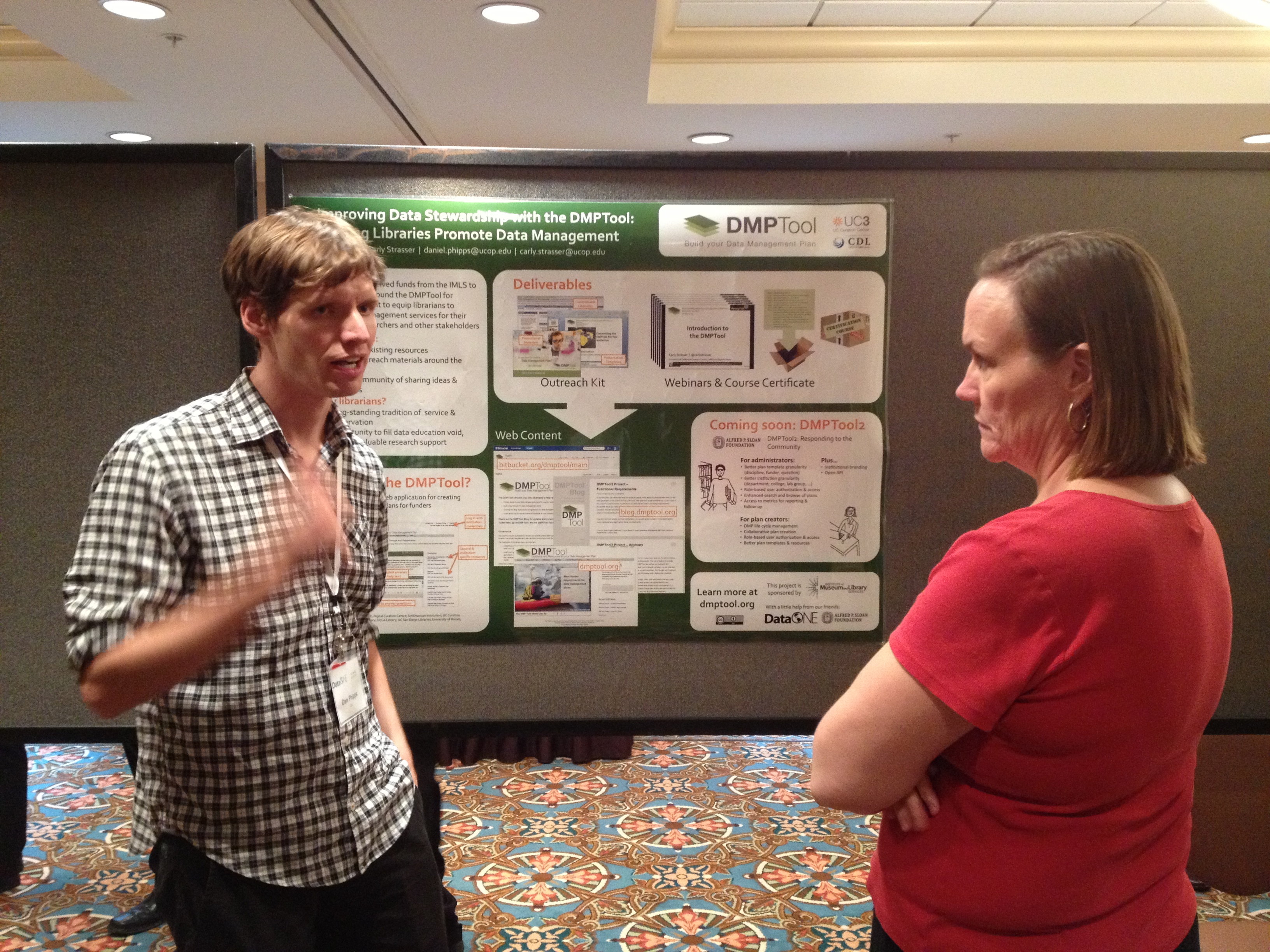
The IMLS Project Poster, presented during the Sunday evening and described with a number of emphatic gestures (as seen here).

The DataONE Users Group meeting in Chapel Hill, North Carolina just concluded, with representatives from data authors, institution support staff, data repositories and aggregators, and other stakeholders in attendance. The DataONE Users Group meeting provides a space for those in attendance to help guide DataONE’s initiatives to better meet their needs. This was a great opportunity to highlight the DMPTool development plans over the coming months, as well as the work we’re doing to provide librarians with high-impact resources for data management support.

The feedback we received with regards to the DMPTool was both extremely positive and useful. As the first step in the data management lifecycle, the DMPTool as a planning aid also serves as an excellent entry point for researchers to be made aware of the resources available at their institution. Arming librarians not only with educational resources such as our webinar series and upcoming promotional materials, but also examples of how others in their field have been active in data services is an effective way to fill the leadership gap in data management.

Several attendees mentioned that one of the key problems facing researchers is a lack of knowledge about data management requirements, best practices, and the support resources available through their institution. Whether its funder requirements, guidance on choosing one or more data repositories, or even the proper language to describe a data management plan, providing knowledge support to researchers during the grant writing period is a great way to demonstrate the librarian’s support role during operational implementation.

As we take this new feedback into account, we’ll continue to assemble useful resources not only for data management, but also DMPTool administration. If you weren’t able to make it out to the DUG meeting this year, the presentations are available at the DataONE User Group page. Feel free to drop us a line at uc3@ucop.edu or email me directly at daniel.phipps@ucop.edu – we’re always interested in new ways that the DMPTool can support the research community.

The poster we presented at the meeting is available on figshare: DOI 10.6084/m9.figshare.730643

ARL and DMPTool

The Association of Research Libraries is a nonprofit organization of 125 research libraries at comprehensive, research-extensive institutions in the US and Canada that share similar research missions, aspirations, and achievements.

DID YOU KNOW…?

  • 46% of all ARL institutions are current partners of the DMPTool.
  • 50% of all researchers on DMPTool to date are from ARL institutions.

Update: July 22, 2013: With the recent addition of five institutions, half (50%) of all 125 ARL institutions are now members of DMPTool!

Review: Customizing the DMPTool

On June 18th we gave a webinar on customizing the DMPTool for your institution. While the recording and slides from that presentation can be found on the webinar series page, here’s a brief review of the major topics that were covered.

What Do We Mean by Customization?

The DMPTool comes pre-populated with funder-provided information on how to construct a data management plan. Customizing the tool gives you a chance to modify what grant writers see when using the tool. Broken up into separate sections, administrators can provide help text, suggested answers, contacts at the institution, and resource links such as best practices guides or support groups.

http://commons.wikimedia.org/wiki/File:Researchers_review_ documents.jpg

The DMPTool’s audience includes students, researchers, and grant writers. Source: wikimedia commons

Customizing the DMPTool for your users can accomplish two goals. First, by setting up authentication and linking to resources and people from your institution, it encourages confidence in users. There are a lot of resources out there, so researchers will be looking for familiar signs. Second, you can ensure that your researchers are being connected to reliable, up-to-date information.

How to Customize

There are three steps to the customization process. Step one is to set up Shibboleth Authentication. Shibboleth is an open source software package used by many universities to provide a single login for multiple services. This can be extended to work with the DMPTool, to allow researchers to use the same login as other tools at their institution. Shibboleth is not required for customization, but without it researchers have to create their own account which can be a barrier to access. More information on how to set up shibboleth with DMPTool can be found at our website.

The second step is the customization documentation itself. This is where you provide information about your institution, and specific advice for each funder. These documents can be found at the Templates for Institutional Customization page on our bitbucket wiki. The institution settings document lets you select the email address where help requests should be sent as well as resource links that are relevant for each step in the process.

fundertemplate

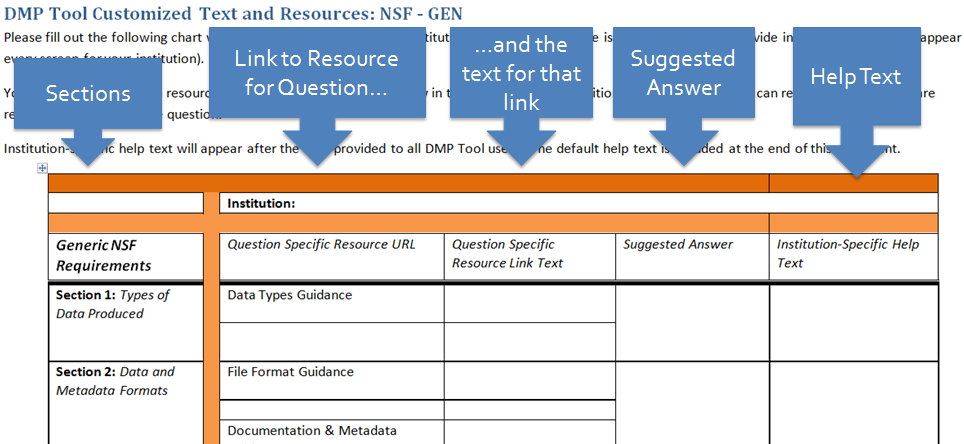
The 5 columns of the Funder Template, and the Information they need

We break up the other documents by funding agency to give you as much control as possible with your customization. Each document is broken up into different sections, and lets you provide resource links relevant to that question, a suggested answer, and help text.

Once these documents are filled out, you can attach them to an email and send them to uc3@ucop.edu for submission. We’ll populate the fields with the information you provide, and add your institution to the dropdown list at the DMPTool website.

For More Information…

We’ve started an Example Documentation page where institutions can share how they’ve used DMPTool customization. This is a great place to start if you want to see how others have customized the DMPTool.

For a more in-depth breakdown of how to customize the tool, as well how we’re working to provide more administrative control in future versions of the DMPTool, check out the full webinar. If you have any questions or feedback, feel free to email me at daniel.phipps@ucop.edu or uc3@ucop.edu.

DMPTool’s Top 10

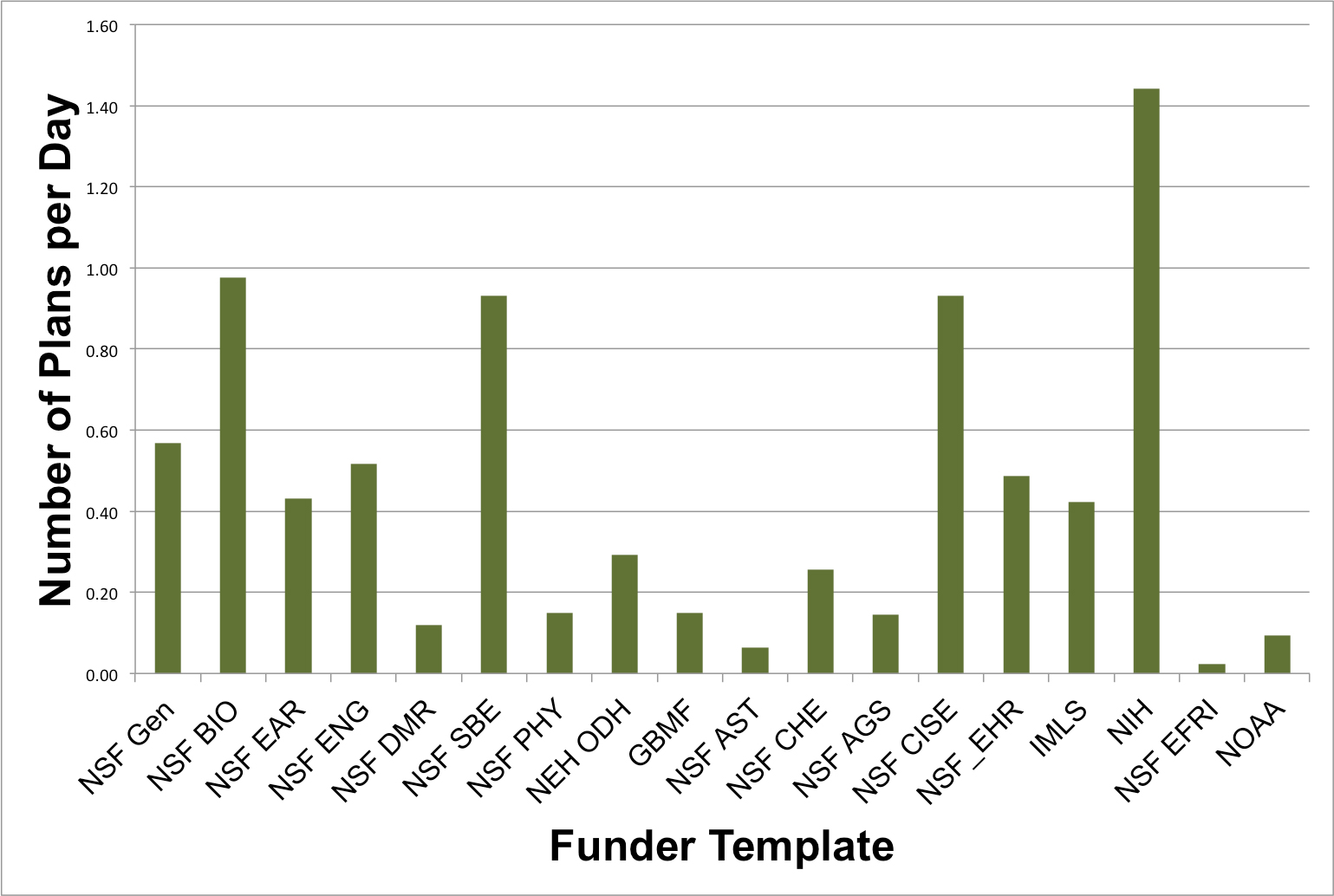
We have determined the top-ranked institutions that use the DMPTool based on the number of users and of plans they create (October 2011 – Present).

Top 10 Institutions by Number of Users:

The following institutions have produced the most number of users on DMPTool.

Institution # Users
University of Illinois Urbana-Champaign 161
UC San Diego 146
UCLA 141
Stanford 133
North Carolina State 121
UC Davis 114
University of Virginia 109
University of Washington 97
UC Berkeley 92
UC Irvine 80

Top 10 Institutions by Number of Plans:

The following institutions have produced the most data management plans using DMPTool.

Institution # Plans
UC San Diego 189
University of Illinois Urbana Champaign 138
University of Virginia 115
North Carolina State 105
UCLA 103
University of North Texas 97
Stanford 88
UC Berkeley 78
University of North Carolina – Chapel Hill 74
UC Davis 73

Congratulations to the eight institutions that made both lists: North Carolina State University, Stanford University, UC Berkeley, UC Davis, UCLA, UC San Diego, University of Illinois, and University of Virginia.

Data Management Resources: Libguides

What are Libguides?

While putting together our upcoming webinar on existing data management resources, one consistent source of useful information was librarian-authored research guides called libguides, hosted by various institutions. While we’ll be going into more detail in the webinar itself, I wanted to talk about what makes the libguide platform especially useful to librarians looking to make a data management guide for their patrons.

Libguides are designed to be made up of replaceable parts that are easy to share with other guides. Img source: Wikimedia Commons

Libguides are a web platform designed for librarians to create and share research guides, without having to tangle with web design tools. They can be used to answer frequently asked questions, highlight materials in the catalog, or point to useful outside resources. Organizationally, Libguides are made up of tabs and boxes. Tabs allow you to create sub-pages within the guide to keep content organized. Each page is populated with boxes that contain different kinds of content, such as lists of links, RSS feeds, or videos.

The Power of Linked Pages

Aside from allowing librarians to assemble simple page structures, breaking the site into various boxes allows users to share individual components of their guides with other librarians for use in their own guides. This means useful information can be repeated across multiple guides without reinventing the wheel. This modularity makes libguides a great tool for disseminating data management information. Not only can librarians create a guide specifically to answer questions about data issues, but relevant pages can be easily ported to subject specific guides. By properly organizing the information on your data management libguide, you can easily re-use pages specific to the sciences or humanities to their relevant topics. Later, when  you update these pages the changes will automatically be reflected across all the guides that are using it as a linked page.

When sitting down to create a data management libguide, you should design it in such a way where it can be useful to researchers who might only see a portion of it. Properly sharing individual tabs will not only capture researchers who might not have started considering the data management element of their work, but also guide traffic to the main data management site. Reaching out to the authors of frequently visited libguides can be a good way to add information that might be of value to their patrons.

For examples of data management libguides and other useful resources, check out the DMPTool Community Resources Page. If you need technical advice on how to customize your libguide, check out guidefaq.com to find answers to frequently asked questions about the libguide platform.

DMPTool2 Project – May 2013 Report

Overview

DMPTool2 is at the point of transition from formal planning activities to startup efforts toward the execution phases of the project.

Technical Team

Many of the planning and preparation goals have been accomplished and the technical team is moving forward on development. Both application developers have been hired and have commenced work as of May 1st. The functional specifications have been revised and reviewed and initial wireframes have been drafted. We are currently working through revising and making minor changes to wireframes and user stories and will present them to Researcher and Administrative User Advisory Boards for feedback on May 30th. The updated technical development schedule is nearly complete and will be shared soon.

Communications/Outreach Team

Candidate evaluation for the Sloan Outreach Coordinator position began on May 2nd, as planned, and we hope to have that position filled within the next month or so. The Researcher and Administrative User Advisory Boards have begun meeting, with initial meetings both in early May. These meetings focused on review and discussion of high-level project issues and technical specifications. The next set of meetings is scheduled for the end of May, and will focus on more targeted feedback.  With the newly implemented governance structure in place, we continue to enroll institutions as “Partners” through signed collaborative agreements. We maintain our goal to enroll all currently authenticating institutions by the end of May. Furthermore, the outreach team has successfully launched a webinar series on the DMPTool blog, already garnering significant community interest.

Metrics

There have been significant developments in project metrics. The outcome metrics outlined in Sloan Foundation communications will be used to track and evaluate project success. We are currently creating objective-based strategies for each. Longer-term impact metrics are still in development and we are still evaluating the best choices. We will seek more targeted feedback on them during the meetings at the end of May, and likely via broader community discussion opportunities.

Overall Project

Though we expect that certain project aspects may carry into early next year due to previously stated delays, we are quickly catching up to our original project plans. Now that the project is fully staffed, with a complete set of requirements, we are moving forward quickly on development.

-Andrew Sallans, University of Virginia Library, DMPTool2 Project Manager


Data Services Environmental Scan: First Steps

Author: Shannon Smith, U.S. Fish and Wildlife Service

Source: WikiMedia Commons

As a library, taking on an increased support role for data management is a long-term project that involves coordinating with groups institution-wide. Environmental scan interviews are a vital first step. They can help you find advocates in other departments, and find trouble on the horizon. We’ll be discussing how to perform an environmental scan in our webinar series this summer, but there are steps you can take within your library to begin the process. The first task at hand is to identify your own library’s existing services.

The library self-assessment is a critical first step to developing an environmental scan. Before speaking with the other technical or research support groups at your institution, you should have a written list of the services, initiatives, and plans that your library has undertaken.

What are you looking for?

The purpose of assembling this written list is to inform your later interviews and to help you focus on you institution’s priorities. In an ideal world, a thorough survey of library patrons and the services they need from the library would not only give you insight into how you focus your activities, but also give you ammunition when speaking to other departments about the importance of library data services. In the short term, speaking to your fellow librarians (especially reference, research, or subject specialists) about their interactions with researchers can give you a quick-and-dirty overview of where to focus your efforts. Looking at other university libguides on data services can also give you an idea of things researchers find useful.

Interviewing your Library’s Director

The other half of the internal review is the top-down approach. Taking what you’ve learned about the current state of affairs, meeting with your library director can give you broader, long term goals. Other, more detailed guides on how to conduct informative interviews exist, but broadly it’s useful to approach the interview with a pre-established set of goals for information you want to leave with, an understanding of how formal/detailed the interview will be, and a list of questions to ask. This should give you a wider-scale view of your Library’s data services work, and how it fits in with the campus’ larger scale priorities. You may also walk away with a better understanding of other groups on campus with a stake in data management for later use, as well as the internal organization of your own library.

Review, Recycle, Remix

While a self-assessment is the first step to developing an environmental scan of the whole institution, it also stands alone as a short-term thing librarians can do to start working on their own data practices. Before rushing off to coordinate with researchers, grant writing offices, or IT make sure you take the time to review the information you’re getting from your patrons, fellow librarians, and other staff. Giving yourself some weeks to digest this information will give you a better idea of what you can do in-house, what tasks require outside collaboration, and what might be out-of-scope for now.

For more on environmental scanning and other important aspects of data services at your library, keep an eye on our webinar page over the coming months.