DMPTool maintenance, Thu Sept 26, 6:00am-7:30am (PDT)

Gear Wheels


Gear Wheels Source: Flickr, Username: freefotouk


The DMPTool will be unavailable on Thursday Sept 26 from 6:00am-7:30am (PDT) to perform routine maintenance. It’s possible that the maintenance won’t require the entire period, but we’re scheduling the downtime for 90 minutes. Please contact us at uc3@ucop.edu with any questions or concerns. We apologize for the inconvenience.

Survey: Tools to Integrate with DMPTool

Image

A quick question. Source: Flickr, Username: drachmann

One of our goals to help guide the development of the DMPTool is to provide guidance on how the DMPTool can support data management beyond the planning stage. One of the best ways to do that is to look at the tools our community already uses. We’ve put together a 3-question survey about the tools you’d like to see the DMPTool be able to work with. Whether it’s supporting more in-depth data management planning, connecting with repositories, or just keeping a record of your institution’s good data practices, what would you like to see the DMPTool connect to?

The survey can be found here.

Talking Points Webinar and Resources

http://www.flickr.com/photos/65555826@N00/2900631165/in/photolist-5qjuAa-5ymVrb-5RyGsi

Source: Flickr – Username: Wonderferret

This week we hosted a follow-up to our environmental scan webinar to talk about the tools and research that goes into an effective outreach program. Data Services not only has a knowledge component, but also requires technical support, administration, and researcher involvement. No one person, or even one department, can do all these things alone.

The Library as the Hub

Data services is one of the areas that modern research libraries can really make a major impact, filling the leadership vacuum that so many institutions currently face. While information architecture and data archiving are (relatively) new fields of inquiry, they are built on a long tradition of understanding how information is accessed, used, and understood. Libraries have a mandate to collect and coordinate knowledge resources for the betterment of the public or their host institutions.

How does this Relate to Data Management Planning?

Libraries have a future as the destination for data. Even resources that may not be hosted at the physical library, such as census data or other publicly available sources, can still be cataloged and made accessible to library patrons in ways that support research and academic inquiry. Fostering relationships with data producers in the sciences, social sciences, or humanities will help to ensure that not only will these data be available in the future, but they’ll be useful as well.

If you want to learn more about how to effectively coordinate within your institution to tackle data services, check out our webinar series to find the environmental scan and talking points recordings. You should also check our Outreach Materials for a 2-page document on effective talking point formatting and a series of useful examples.

DMPTool2 Project — August 2013 Report

Overview

We have had a very busy past month, with lots of progress on all fronts.  We are rather deep into application development, finalizing UI plans and transitioning to design work, and are aggressively reaching out to expand the user base of the DMPTool.  During this time, we’ve also come to the realization that our project timeline was imperfect, and we are more realistically looking at a full completion at the beginning of February 2014.  We’ve added a few extra pieces of design, testing, and data porting which weren’t originally included, but which we see as critical.

Technical Team

During the past month the development team has been focused and has completed functionality for the profile, administrator, institution, and authorization pages, authorization and role assignments, and has been doing significant testing.  The team will soon move the application over to a stage environment for further testing.  The UI sub-team has spent significant time on wireframe revision to cover all anticipated immediate use cases.  These wireframes are now in transition to a design vendor for development of the graphical design version for the end user.

Communications/Outreach Team

The outreach team is now actively recruiting new institutions to enable Shibboleth authentication, and has already had a very positive response.  All of this work is being tracked through a customer relationship management (CRM) system, which makes coordination of communications across the team far more efficient than previously.   The first major push has been on ARL institutions to work on advancing that metric.    The third advisory board meetings have been scheduled for August and September.  The team has also increased presentations on the project over the past month, with Carly Strasser and Amber Budden presenting at the annual Ecological Society of America conference, and Sarah Shreeves presenting at the CLIR Data Curation Fellows meeting and at the BePress Digital Commons meeting.   We have also submitted proposals to the Digital Library Federation Forum (accepted), the American Geophysical Union meeting (waiting), the HubZero HUBBub meeting (accepted), and the Research Data Alliance Plenary 2 (about to submit).

Metrics

As many of the metrics are dependent upon the release of the new version, we have no progress to report on those.  The metrics involving growth of our ARL and Shibboleth user bases are advancing now with dedicated focus from the outreach team, and we expect to see improved numbers on those by next month.  Our metrics for doubling user in user numbers and plans are nearly complete, and may be reached by the end of August.

Overall Project

We are presently right in the middle of the most work intensive period of the project across all areas, and expect to report significant advancements by next month.   As noted in the beginning, the schedule has been adjusted slightly, and delivery of a production version of the new tool should be expected for February 2014 instead of our original November date.

Report on DMPTool at ESA 2013

Last week in Minneapolis, about 4,000 ecologists got together to geek out and enjoy the midwest for eight days. The DMPTool had a couple of appearances in the course of this 2013 Ecological Society of America Meeting– a workshop on managing ecological data and a session on data management planning and the DMPTool. It was also mentioned in numerous presentations about the DataONE Investigator Toolkit, of which the DMPTool is a part.

Here I want to briefly mention the special session on the DMPTool, which occurred on the first official day of #ESA2013. The session was 75 minutes long, and Bill Michener of DataONE and I were sharing the podium. He planned to introduce DMPs generally, followed by my explanation and demonstration of the DMPTool, including the new version of the tool due out in Winter 2013-2014.

Fifteen minutes before the presentations were due to start, the room was packed. Attendees were sitting on the floor in the aisles by 5 minutes before, and there was a nonstop trickle of attendees entering throughout the 75 minute session. The catch? We had no power.

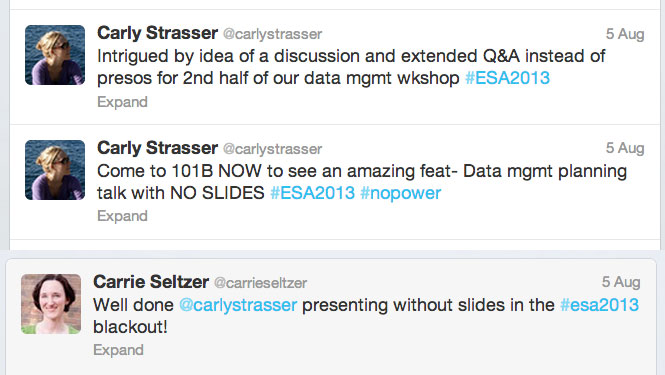
That’s right: Bill and I were forced to talk about data management plans, demo the DMPTool, and discuss future plans to a packed room, all without a microphone, a projector, or even a chalk board. We managed to get through the session, and folks seemed to appreciate the impromptu soliloquies on data management by myself and Bill. The power came on about 5 minutes before the close of the session (of course), at which point I scurried behind the podium to show screen shots of the DMPTool. By the time I looked up from my laptop, about 60% of the audience had left. Apparently slides were not the big draw for our session.

My takeaway lessons? When giving a talk, be prepared for anything; people enjoy the element of surprise and improvisation; and researchers are dying to learn about DMPs, regardless of the potential hurdles put before them. This is most likely due to funder requirements for DMPs, but I’d like to think it also relates to my and Bill’s dulcet tones.

The slides I didn’t get to show are available on slideshare.

Screen-Shot-2013-08-12-at-8.37.16-AM

Digest: Upcoming DMPTool Activities

Digital Library Federation Spotlight

The DMPTool was recently featured in the Digital Library Federation Community Spotlight. Written by Sarah Shreeves at the University of Illinois at Urbana Champaign, the article provides a comprehensive breakdown of the tool’s use, it’s growth over the past few years, and upcoming developments. Both the librarian outreach and development projects are also highlighted, as well as some of the DMPTool2 functionality we can look forward to. If you haven’t seen it yet, it’s a great read!

Upcoming Conferences

DMPTool: On the Road. Source: wikimedia commons

Starting this coming Sunday, the Ecological Society of America’s 2013 meeting will convene in Minneapolis. Among a number of excellent data focused sessions the DMPTool will be featured during Monday’s Creating Effective Data Management Plans for Ecological Research.

In the upcoming Digital Library Federation Forum in Austin Texas, Andrew Sallans will be leading a session titled DMPTool 2: Improvements and Outreach. The DLF Forum schedule is forthcoming, but you can learn more about the fall forum at the DLF Website.

We also recently submitted two proposals to the American Geophysical Union’s December meeting in San Francisco. The first, authored by Patricia Cruise and Andrew Sallans, centers on the role that data management planning can play within the larger data lifecycle by providing guidance, resources and outreach. The other, written by Carly Strasser and Dan Phipps, is focused on the resources that exist to guide librarians to adopting leadership roles in data management within their communities.

As we continue to ramp up outreach, development, and with new participants and partners, we’re expecting the rest of 2013 to be a busy time for the DMPTool project, and will be providing details as we get closer to those dates.

DMPTool2 Project — July 2013 Report

Overview

While technical developments are still underway and on-time, much of the past month’s focus has been on outreach efforts. Not only has the outreach team achieved their objectives for the month, but they have also developed several initiatives that impact the project and its trajectory in positive ways.

Technical Team

In the last month, the technical team has completed all Phase One stages of their development schedule. With all login functionality pieces in place, the team is prepared to begin Phase Two—implementing all remaining functions of the tool, with an estimated completion at the end of September. Meanwhile, user interface (UI) design is underway. Site wireframes are undergoing a second round of review, with a more aesthetic focus. The technical team is collaborating with several others on such design decisions as branding and outsourcing. The team has engaged in continued talks with the Center for Open Science (COS) regarding implementing DMPTool into Open Science Framework. A similar opportunity has arisen with the Gulf of Mexico Research Initiative, who have expressed interest in implementing DMPTool in a similar way. Discussions with these organizations should continue within the next month or so. These developments have placed the technical team on-track toward the intended DMPTool2 release date.

Communications/Outreach Team

The outreach team has made significant strides during the past month. The outreach schedule is complete and will be finalized and implemented this week. The team publicized functional requirements and have not only received public enhancements requests but also developed a policy to address such requests with the assistance of the technical team. They have also up a customer relationship management system, in the interest of reaching our Shibboleth and ARL institution authentication goals. The team has coordinated responses to Advisory Board requests and is currently assessing logistics for August meetings. The webinar series continues to meet success, with an average turnout of approximately 70 participants. The consensus is that there is a core of repeat librarian participants. In response, the team is brainstorming alternative outlets to reach other stakeholders. Other current brainstorming projects include: developing a “tiers of participation” matrix to clarify institutional status confusion, and seeking use cases for the technical team. Finally, the outreach team has scheduled an end-of-project meeting for Spring, 2014.

Metrics

Upon assessing progress toward each goal outlined in Sloan Foundation communications, the project management team and the outreach team set strategic achievement plans in motion. The outreach team continues to implement such plans as the project management team monitors progress. An extensive project tracking system has been set up and distributed to all team members with weekly status updates. Several goals are on-track, including those pertaining to: conference attendance, webinars, open API testing, doubling the user base, and doubling the number of plans. The project management team continues to seek feedback from Advisory Boards as well as through community outreach regarding impact metrics.

Overall Project

As previously expected, the team has made significant progress in the past month. There has been a lot of activity in all areas of the group. With the technical team caught up and the now-expanded outreach team doubling their efforts, a smaller number of project items may carry into next year than previously determined. The project is, therefore, on track to completion by January, 2014.

DMPTool at the DataONE Users Group Meeting

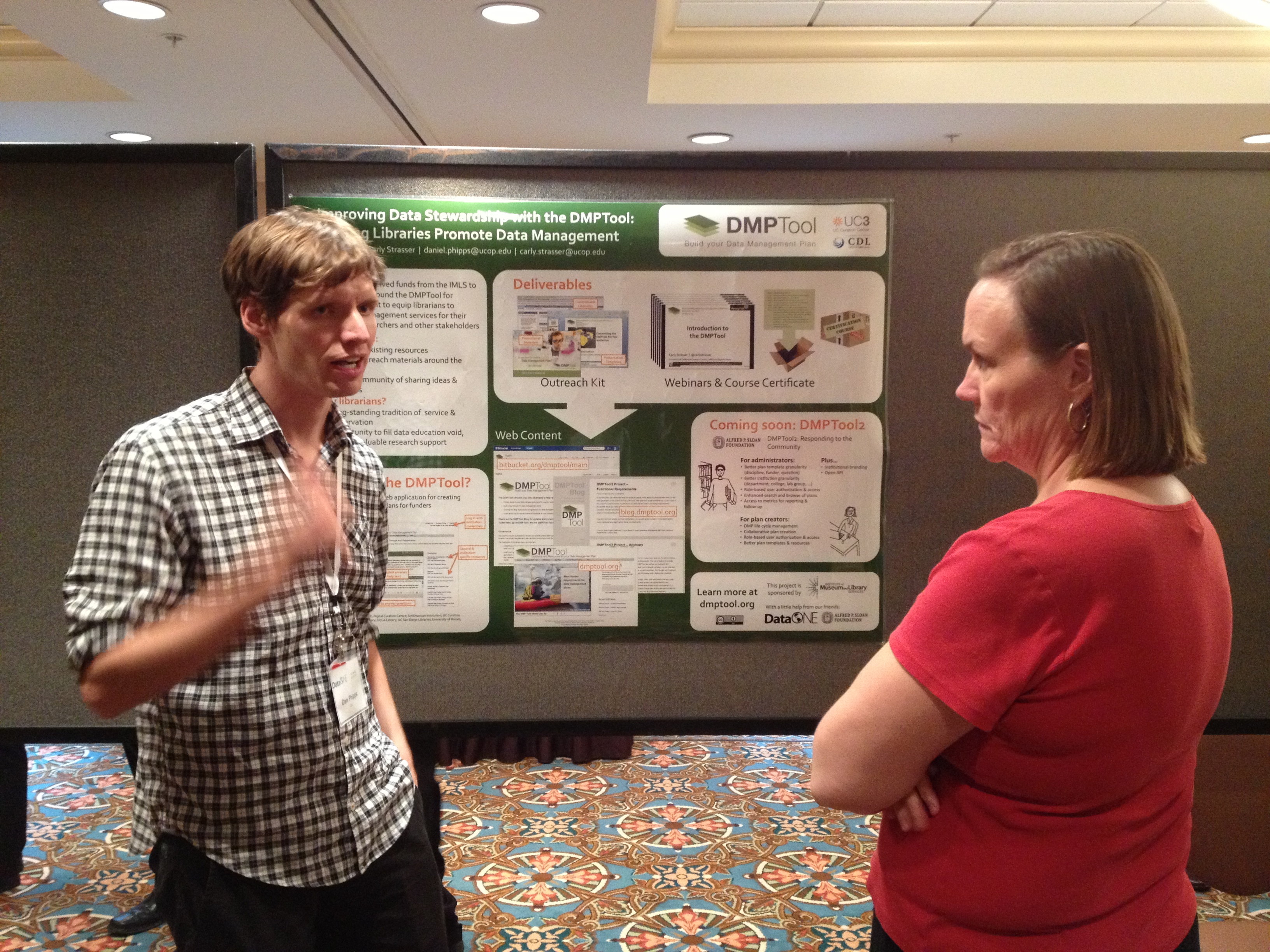
The IMLS Project Poster, presented during the Sunday evening and described with a number of emphatic gestures (as seen here).

The DataONE Users Group meeting in Chapel Hill, North Carolina just concluded, with representatives from data authors, institution support staff, data repositories and aggregators, and other stakeholders in attendance. The DataONE Users Group meeting provides a space for those in attendance to help guide DataONE’s initiatives to better meet their needs. This was a great opportunity to highlight the DMPTool development plans over the coming months, as well as the work we’re doing to provide librarians with high-impact resources for data management support.

The feedback we received with regards to the DMPTool was both extremely positive and useful. As the first step in the data management lifecycle, the DMPTool as a planning aid also serves as an excellent entry point for researchers to be made aware of the resources available at their institution. Arming librarians not only with educational resources such as our webinar series and upcoming promotional materials, but also examples of how others in their field have been active in data services is an effective way to fill the leadership gap in data management.

Several attendees mentioned that one of the key problems facing researchers is a lack of knowledge about data management requirements, best practices, and the support resources available through their institution. Whether its funder requirements, guidance on choosing one or more data repositories, or even the proper language to describe a data management plan, providing knowledge support to researchers during the grant writing period is a great way to demonstrate the librarian’s support role during operational implementation.

As we take this new feedback into account, we’ll continue to assemble useful resources not only for data management, but also DMPTool administration. If you weren’t able to make it out to the DUG meeting this year, the presentations are available at the DataONE User Group page. Feel free to drop us a line at uc3@ucop.edu or email me directly at daniel.phipps@ucop.edu – we’re always interested in new ways that the DMPTool can support the research community.

The poster we presented at the meeting is available on figshare: DOI 10.6084/m9.figshare.730643

ARL and DMPTool

The Association of Research Libraries is a nonprofit organization of 125 research libraries at comprehensive, research-extensive institutions in the US and Canada that share similar research missions, aspirations, and achievements.

DID YOU KNOW…?

  • 46% of all ARL institutions are current partners of the DMPTool.
  • 50% of all researchers on DMPTool to date are from ARL institutions.

Update: July 22, 2013: With the recent addition of five institutions, half (50%) of all 125 ARL institutions are now members of DMPTool!