Progress Update: Matching Related Works to Data Management Plans

TL;DR

  • We’re making progress on our plan to match DMPs to associated research outputs.
  • We’ve brought in partners from COKI who have applied machine-learning tools to match based on the content of a DMP, not just structured metadata.
  • We’re getting feedback from our maDMSP pilot project to learn from our first pass.
  • In our new rebuilt tool, we plan to have an automated system to show researchers potential connected research outputs to add to the DMP record.

Have you ever looked at an older Data Management Plan (DMP) and wondered where you could find resulting datasets it mentioned would be shared? Even if you don’t sit around reading DMPs for fun like we do, you can imagine how useful it would be to have a way to track and find published research outputs from from a grant proposal or research protocol.

To make this kind of discovery easier, we aim to make DMPs more than just static documents used only in grant submissions.  By using the rich information already available in a DMP, we can create dynamic connections between the planned research outputs — such as datasets, software, preprints, and traditional papers — and their eventual appearance in repositories, citation indexes, or other platforms.

Rather than linking each output manually to their DMP, we’re using the new structure of our machine actionable data management and sharing plans (maDMSPs) from our rebuild to help automate these connections as much as possible.  By scanning relevant repositories and matching the metadata to information in published DMPs, we can find potential connections that researchers or librarians just have to confirm or reject, without adding the information themselves.  This keeps them in control and helps ensure connections are accurate, while reducing the burden of how much information they have to enter. 

Image from an early version of this in the DMP Tool showing a list of citations for potential marches with buttons to Review and a status column showing them as Approved or Pending

This helps support the FAIR principles, particularly making the data outputs more findable, and helps transform DMPs into useful, living documents that provide a map to a research project’s outputs throughout the research lifecycle.

Funders, librarians, grant administrators, research offices, and other researchers will all benefit from a tracking system like this being available. And thanks to a grant from the Chan Zuckerberg Initiative (CZI), we were able to start developing and improving the technology to start searching across the scholarly ecosystem  and matching to DMPs.  

The Matching Process

AI generated image from Google Gemini of a monkey holding two pieces of paper next to each other

We started with DataCite, matching based on titles, contributors (names and ORCIDs), affiliations, and funders (names, RORs and Crossref funder ids).  Turns out, when you have a lot of prolific researchers, they can have many different projects going on in the same topic area, so that’s not always enough information to to find the dataset from this particular project. We don’t want to just find any datasets or papers that any monkey-researcher has published about monkeys, we want to find the ones that are from this particular grant about monkey behavior.

To help expand the datasets and other outputs we could find, we partnered with the Curtin Open Knowledge Initiative (COKI) to ingest information from OpenAlex and Crossref, and we’re working on including additional sources like the Data Citation Corpus from Make Data Count. COKI’s developers are also applying machine-learning, using embeddings generated by large language models and vector similarity search to compare the text from the title and abstract of a DMP to those descriptive fields within the datasets, rather than just the metadata for authors and funders.  That will help us match if, say, the DMP mentions “monkeys” but the dataset uses the work “simiiformes.”

To confirm the matches, we used pilot maDMSPs from institutions that are part of our projects with our partners at the Association of Research Libraries, funded by the Institute of Museum and Library Sciences and the National Science Foundation.  This process recently yielded a list of 1,525 potential matches to registered DMPs from the pilot institutions. We asked members of the pilot cohort to evaluate the accuracy of these matches, providing us with a set of training data we can use to test and refine our models.  For now we provided the potential matches in a Google Sheet, but in the future with our rebuild we plan to integrate this flow directly in the tool.

Screenshot from one university’s Google Sheet for matching DMP-IDs to research output DOIs, showing some marked as Yes, No, and Unsure for if its a match

Initial Findings

It will take some time for the partners to finish judging all the matches, but so far about half of the potential related works were confirmed as related to the DMP. This means we’ve got a good start and can use the ones that didn’t match to train our model better.  We’ll use those false positives, as well as false negatives gathered from partners, to refine our matching and get better over time.  Since we’re asking the researchers to approve the matches, we’re not too worried about false matches, but we do want to find as many as possible.

This process is still early, but here are some of our initial learnings:

  • Data normalization is an important and often challenging step within the matching process. In order to match DMPs to different datasets, we need to make sure that each field is represented consistently. Even a structured identifier like a DOI can be represented with many different formats across and within the sources we’re searching.  For example, sometimes they might include the full URL, sometimes just the identifier, and some are cut off and therefore have an incorrect ID that needs to be corrected in order to resolve. That’s just one small example, but there are many more that make the cleanup difficult, including normalization of affiliation, funder, grant and researcher identifiers across and within the datasets.  Without the ability to properly parse the information, even a seemingly comprehensive source of data may not be useful for finding matches.
  • Articles are still much easier to find and match than datasets. This is not surprising, given the more robust metadata associated with DOIs for articles that make them easier to find. Data deposited into repositories often does not have the same level of metadata available to match, if a DOI and associated metadata are even available at all.  We’re hoping we can use those articles, which may mention datasets, to find more matches in our next pass.
  • There is not likely to be a magic solution that gets us to completely automate the process of matching a research output to a DMP without changes in our scholarly infrastructure.  Researchers conduct a lot of research in the same topic area, so it’s difficult to know for sure if a paper or dataset came from a DMP, unless they specifically include these references.  There are ways to improve this, such as using DOIs and their metadata to create bi-directional links between funding and their outputs (as opposed to one-directional use of grant identifiers), including in data repositories. DataCite and Crossref are both actively working to build a community around these practices, but many challenges still remain. Because of this, we plan to have the researcher confirm matches before they are added to a record, rather than attempt to add them automatically.

Next Steps

We’re continuing to spend most of our development work on our site rebuild, which is why we’re grateful for our funding from CZI and our partnership with COKI to improve our matching.  Our next step is including information from the Make Data Count Data Citation Corpus, as well as following up on the initial matches once pilot partners finish their determinations.

We hope to have this Related Works flow added to our rebuilt dmptool.org website in the future.  The mockup is below (where we show researchers that we have found potential related works on a DMP, and would then ask them to confirm if it’s related so it can be added to the metadata for the DMP-ID and become part of the scholarly record).  We’ll want to balance confidence and breadth, finding an appropriate sensitivity so that we don’t miss potential matches but also don’t spam people with too many unrelated works.

Mockup of a project block in the new DMP Tool which a red pip and test saying "Related works found"
Mockup of a project block in the new DMP Tool which a red pip and test saying “Related works found”

If you have feedback on how you would want this process to work, feel free to reach out! 
DMPTool Funder Templates Updated

We are excited to announce the completion of the first project of our newly established DMPTool Editorial board. As of September 2020, the Board has audited 36 funder templates within the DMPTool and updated the templates when necessary to reflect current proposal requirements and ensure all funder related content is up to date.

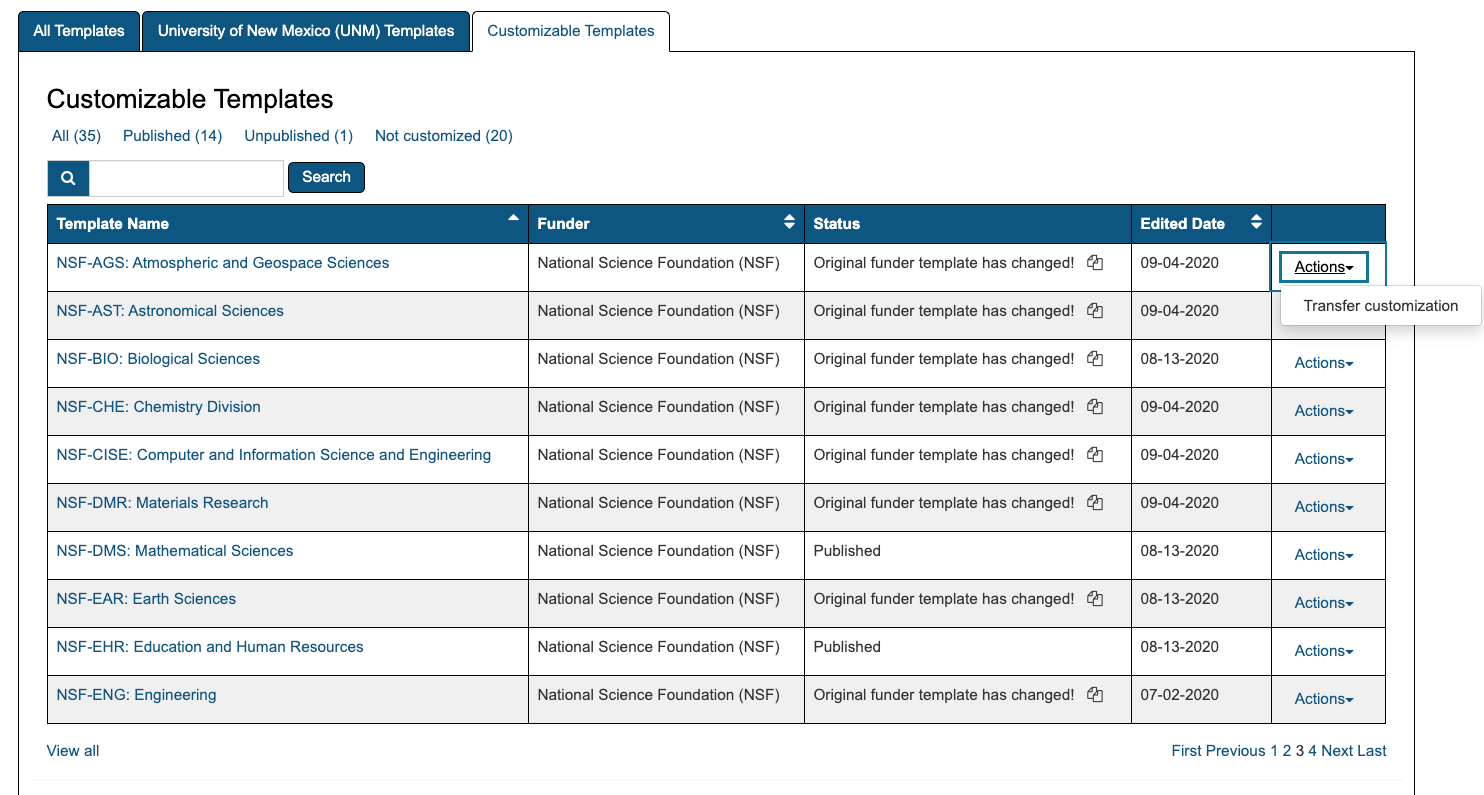
Template updates mean that admins will now need to transfer any customizations you may have created for these templates (instructions here). 

None of the updates made to templates affect the core requirements of the DMPs and updates largely involve correcting links, resources, and other data management planning requirements. A detailed summary of the changes for each template is below and you can view all templates on the DMPTool Funder Requirements page.

The critical work keeping the DMPTool in line with current funder requirements would not have been possible without the effort, expertise, and excellence of our volunteer Editorial Board and we at the DMPTool are endlessly grateful for their commitment to supporting the tool. Please join us in recognizing their contributions and thanking them for their work supporting our shared infrastructure advancing research data management.

  • Heather L Barnes, PhD, Digital Curation Librarian, Wake Forest University
  • Raj Kumar Bhardwaj, PhD, Librarian, St Stephen’s College, University of Delhi, India
  • Renata G. Curty, PhD, Social Sciences Data Curator, University of California, Santa Barbara
  • Jennifer Doty, Research Data Librarian, Emory University
  • Nina Exner, Research Data Librarian, Virginia Commonwealth University
  • Geoff Hamm, PhD, Scientific Publications Coordinator, Lawrence Berkeley National Laboratory
  • Janice Hermer, Health Sciences Liaison Librarian, Arizona State University
  • Megan O’Donnell, Data Services Librarian, Iowa State University
  • Reid Otsuji, Data Curation Specialist Librarian, University of California, San Diego
  • Nick Ruhs, PhD, STEM Data & Research Librarian, Florida State University
  • Anna Sackmann, Science Data & Engineering Librarian, University of California, Berkeley
  • Bridget Thrasher, PhD, Data Stewardship Coordinator, Associate Scientist III, National Center for Atmospheric Research
  • Douglas L. Varner, Assistant Dean for Information Management / Chief Biomedical Informationist, Georgetown University Medical Center

Together with the Editorial Board, we’ll be working on adding new templates to the tool over the coming months. If you have suggestions for funders to be added please let us know by emailing maria.praetzellis@ucop.edu.

Summary of DMPTool Template Updates

All NSF templates were updated to include links to the updated 2020 Proposal & Award Policies and Procedures Guide (2020 PAPPG). Additional updates are summarized below:

NSF-AGS: Atmospheric and Geospace Sciences

  • Updated link to new 2020 PAPPG
  • Edited question text 

BCO-DMO NSF OCE: Biological and Chemical Oceanography

  • Updated link to new 2020 PAPPG
  • Updated questions & links

NSF-CISE: Computer and Information Science and Engineering 

  • Updated link to 2020 PAPPG. 
  • Added “Additional Guidance on Selecting or Evaluating a Repository” under “Plans for Archiving and Preservation”

NSF-DMR: Materials Research

Department of Energy (DOE): Generic

  • Funder links added for Office of Science, and Energy Efficiency/Renewable Energy instructions

Department of Energy (DOE): Office of Science

  • Funder link added
  • Description updated with additional guidance

Institute of Museum and Library Services (IMLS) 

  • Data Management Plans for IMLS are collected via the IMLS Digital Product Form. Originally the form was broken out into three templates within the DMPTool, however we have streamlined the process and combined them into one, comprehensive, template to more accurately reflect current requirements.

National Aeronautics and Space Administration (NASA)

  • Updated text to match the wording of NASA’s description of an ideal DMP 

USDA

  • Reformatted section 1 to make reading easier.
  • Deleted the compliance/reporting section. This is no longer part of the DMP template as it is related to annual reporting. This information was moved to an Overview phase description.
  • Made the guidance links consistent.

Alfred P. Sloan Foundation

National Oceanic and Atmospheric Administration (NOAA)

  • Updated links

U.S. Geological Survey (USGS)

  • Updated questions and links
  • We are continuing to work with USGS and may have additional updates to this template in the near future. 

Minor NSF template updates + other miscellanea

In the waning weeks of summer, we accomplished a wide range of DMPTool things. A bulleted summary of mostly template-related updates is below. Admins should take note that the minor National Science Foundation (NSF) template updates resulted in new versions of the 4 templates in question. This means that admins will need to transfer any customizations you may have created for these templates (instructions here). All users will also see a dismissable notification message when you log into the tool (screenshot below). Read on for more details.

TL;DR

  • Some minor NSF template updates: AGS, EAR, CISE, SBE
  • DCC template now available in Brazilian Portuguese
  • DMPTool templates added to protocols.io
  • Final promo materials shipped and order form closed
  • First successful eduGAIN configuration: welcome to Australian National University!

transfer template customization

notification of template changes

Minor NSF template updates
While working on our machine-actionable DMPs grant, we noticed that a handful of NSF entities had issued updates to DMP requirements since our comprehensive template audit in Feb 2018. The four divisions/directorates listed below posted new documents in Apr 2018 with very minor changes from the previous versions. None of the changes affect the core requirements; most involve updated links and resources. A detailed summary of the changes for each template follows and you can view all templates on the DMPTool Funder Requirements page:

NSF-AGS: Atmospheric and Geospace Sciences

NSF-EAR: Earth Sciences

  • updated PDF document with new links
  • updated appendix with list of recommended repositories and other resources

NSF-CISE: Computer & Information Science & Engineering

  • updated links and reformatting on webpage
  • merged redundant questions about data storage reducing total questions from 7 to 6

NSF-SBE: Social, Behavioral & Economic Sciences

  • new PDF document with no substantive changes; mostly reformatting and removed references to specific repositories

DCC template available in Brazilian Portuguese

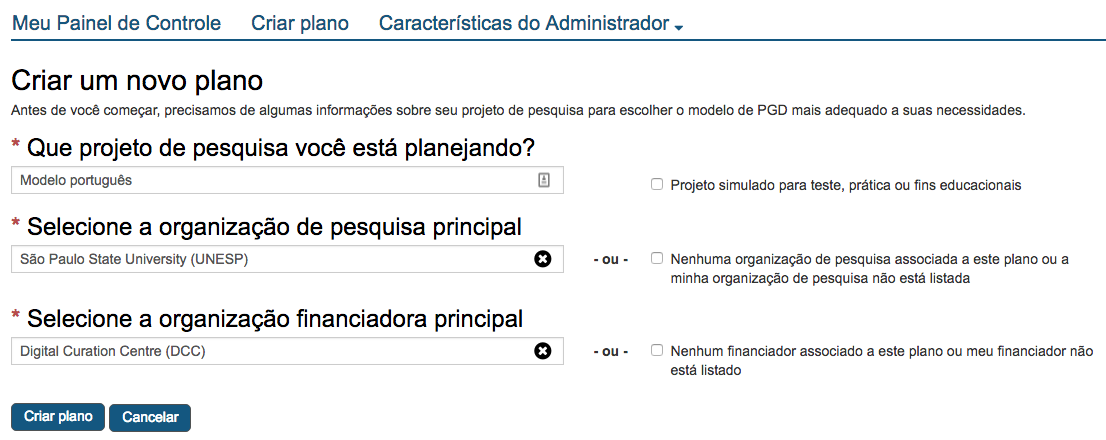
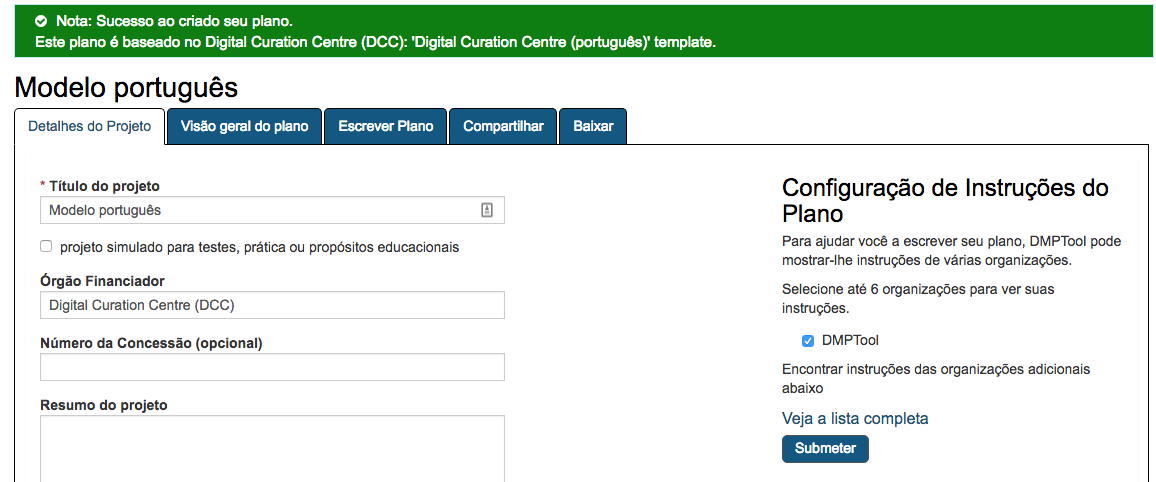
A big thanks to Vitor Silvério Rodrigues from São Paulo State University (UNESP) for translating the DCC template (defined by our Digital Curation Centre partners) into Brazilian Portuguese! This is the default, best practices template provided when users check the box to indicate that they aren’t applying to a specific funder. Anyone can now download the translated template from the Funder Requirements page. The DMPTool is not localized to automatically serve up the translated template for users who set their language to Brazilian Portuguese, however. In order to create a new plan with the translated version, users should make the following selections in the create plan wizard (regardless of language setting):

  1. Enter a project title
  2. Select São Paulo State University (UNESP) as your organization
  3. Select Digital Curation Centre (DCC) as the “funder”
  4. Click button to create plan

Brazilian Portuguese create plan options

new plan with translated DCC template

DMPTool templates added to protocols.io

Protocols.io is an open repository popular among computational and bioinformatics researchers, yet open to all domains, where all scientific protocols (private or public) can be annotated and discussed on step- or protocol-level. Users can also fork (clone) public protocols and publish modified versions as well as connect protocols to published articles and other research outputs, all in the pursuit of increasing transparency and reproducibility.

Scientific protocols are among the many research outputs that we aim to inventory with machine-actionable DMPs. We often promote the notion that DMPs themselves are essentially protocols (i.e., a description of digital research methods), and should be maintained as such over the course of a project. During conversations with the protocols.io team about our intersecting activities, they suggested that we experiment with enabling researchers to create and maintain DMPs on their platform. So we created a Data Management Plans group with two basic DMP templates for users who might prefer this dynamic platform for documenting their digital protocols to an online wizard that produces a static text file. Go check it out and spread the word!

Final promo materials shipped and order form closed

Everyone who placed orders for DMPTool marketing materials (postcards and stickers) should have received them by now, hopefully in time for workshops and other events to kick off the new academic year. The order form for free materials associated with the launch is now closed. Just a reminder that we provide various promo materials (all CC0) on the website so anyone can produce their own swag and spread the DMPTool gospel.

First successful eduGAIN/SSO configuration!

One of the most popular features of the DMPTool is the ability for participating institutions to configure Shibboleth single signon, thereby enabling their users to sign in easily with institutional credentials. Until recently, we only provided this functionality for members of the US-based InCommon federation. There is now an interfederation service called eduGAIN that connects identity federations around the world. We are pleasantly surprised (since Shib can be a tricky, black-box affair) that we were able to configure our first eduGAIN institution: the Australian National University. We hope for (but cannot promise) similar success stories for other identity federations that participate in eduGAIN. The Australian Access Federation is documenting the process and we’re delighted to welcome ANU to the DMPTool community!

First annual funder template pizza party!

template editors

As we approach our target release date of Feb 2018 for the DMP Roadmap platform, the DMPTool team has embarked on a major housekeeping effort. A top-to-bottom content review is underway, and last week we began an audit of the funder templates and guidance. Ten participants gathered for an all-day, pizza-fueled event that amounted to a huge template success (but an epic pizza fail, see evidence below). We were so productive and gratified by the opportunity to analyze multiple DMP policies in a group setting that we decided to make it an annual event. Read on for more DMPTool funder template news + migration plans, followed by brief updates on the DMP Roadmap project and machine-actionable DMPs.

DMPTool funder templates

The DMPTool is a hugely popular community resource in part because it serves as a central clearinghouse of information about DMP requirements and guidance for researchers applying for grants from U.S. funding agencies. Migrating the DMPTool data to the new platform provides an opportunity to update and normalize things to maintain this value. [Side note: we’re also adding a “Last updated” field to the DMP Requirements table as an enhancement in the new platform per your feedback.]

At present the tool contains 32 templates for 16 different federal and private funders. This top 10 templates list demonstrates that our users are especially keen on getting support with NSF and NIH grant proposals, although the NEH is #7, and DOE and others aren’t far behind. Some global usage statistics to put these numbers in context: 26.8k users have created 20k plans; and we have 216 participating institutions (mostly U.S. colleges and universities).

funder-template-table

Our goals for the pizza party included: 1) ensuring that template language comes directly from the most recent versions of funder policy documents; and 2) applying themes (more on themes here). Staying up to date with DMP requirements remains a crowdsourced effort spearheaded by data librarians using the Twitter hashtag #OSTPResp and a Google spreadsheet. In the past year, two additional resources entered the scene: a list of public access plans from U.S. federal agencies at CENDI.gov and this lovely SPARC tool. Using these reference materials and some additional internet research, we updated 7 links to policy documents in the current DMPTool platform (NIH-GDS, NEH-ODH, NSF-CHE, NOAA, USDA-NIFA, Joint Fire Science Program, Sloan) and made some revisions to templates in the new platform (mostly formatting). We also identified some templates that require deeper investigation and/or consultation with agency contacts to verify the best way to present DMP requirements; between now and the release date we’ll continue to work on these templates. In addition, Jackie Wilson is contracting with us to finalize the clean-up of templates and guidance (checking links and guidance text provided by funders).

#pizzafail

#pizzafail

By January we aim to have a beta DMPTool-branded version of the new platform ready for training and testing purposes. Stay tuned for a rollout plan in the new year that includes webinars for institutional administrators, with an orientation to templates and themes. Also, please note that we will be disabling template editing functionality on 18 Dec in the current version of DMPTool to maintain the integrity of template data in the new platform. For admin users who wish to make changes to templates and guidance after that date, you can contact the helpdesk, but it would be great if you can keep changes to a minimum. All other functionality in the current DMPTool will remain the same up to the final migration date (adding new users, institutions, creating and editing plans, etc.)

A million thanks to the 2017 template fixing team: Amy Neeser, Joan Starr, Alana Miller, Jackie Wilson, Marisa Strong, Daniella Lowenberg, Perry Willett, John Chodacki, and Stephen Abrams.

DMP Roadmap update

The co-development team is busy building and refining the final MVP features. The usage dashboard is the last new feature left to add. In the meantime, parallel data migration efforts are underway at DCC to move from the existing 28 DMPonline themes to the new set of 14. By January both service teams will be working on new user guides, updating other content, testing and branding. If all continues to go smoothly, we’ll be on track for a DMP Roadmap demo at IDCC in Barcelona (19–22 Feb) and an official code release. Stay tuned!

Machine-actionable DMPs

On the machine-actionable DMP front, there are two items to report:

  1. We’ll be emailing the various DMP lists shortly to encourage everyone to participate in working meetings for the RDA WGs (DMP Common Standards & Exposing DMPs) at the next plenary. For now mark your calendars for 21–23 Mar and join us in Berlin!
  2. Following on a productive session at FORCE2017, we’re finishing a draft of the 10 Simple Rules for Machine-Actionable DMPs that we will circulate soon soon.

As always, we encourage you to contact us to get involved!

New template: DOD

As far as we can discern, DMPs are not yet a required component of Department of Defense (DOD) grant applications. But in an effort to address numerous user requests for a DOD template, we went ahead and created one based on the draft DOD Public Access Plan issued in Feb 2015, which states:

“This proposed plan is a draft at this point and has not been adopted as part of the DoD regulatory system or as a definitive course of action.”

The (draft) DOD requirements for DMPs are similar to those issued by NSF, NASA, and others so DMPTool users should note the resemblance among these templates. Another similarity is that the DOD plan focuses heavily on access to data underlying published articles. The plan mentions an implementation date at the end of FY 2016 — we will monitor the situation and update the template accordingly. This also presents an opportunity to monitor the new CENDI.gov inventory of public access plans.

Meanwhile, the DOD encourages pilot projects with voluntary submission of articles and data. The Defense Technical Information Center (DTIC) will be responsible for key elements of policy implementation and compliance monitoring (see their prototype DOD Public Access Search for articles that mention DOD funding).

Official news remains pending, but for now we’re happy to provide a draft DOD template for conscientious researchers. If anyone has experience with DOD programs asking for DMPs or related developments, please let us know!

New template: NIJ (DOJ)

The National Institute of Justice (NIJ) is the research, development, and evaluation agency of the U.S. Department of Justice (DOJ). We created a template to assist NIJ funding applicants with preparing a Data Archiving Plan. This is essentially a 1–2 page DMP submitted with grant proposals: 1) to demonstrate your recognition that data sets resulting from your research must be submitted as grant products for archiving and have budgeted accordingly, and 2) to describe how the data will be prepared and documented to allow reproduction of the project’s findings as well as future research that can extend the scientific value of the original project. The policy also notes that “some amount of grant award funds is typically withheld for submission of research data along with the final report and other products/deliverables.”

In most cases, the NIJ requires grantees to deposit their data in the National Archive of Criminal Justice Data (NACJD), which is hosted by ICPSR. The template contains links to guidelines, best practices, FAQs, and other helpful information provided by the NACJD and ICPSR, including specific instructions pertaining to common types of social science data and software.

While the NIJ is not subject to the OSTP Memo, the requirement to submit a Data Archiving Plan has been in place since 2014. We finally added a template in response to a user request.

NASA template update & bug fix

NASA template

NASA logoLast week NASA launched a new Research Portal, with consolidated information regarding data management plans and publications. There are no changes to the DMP requirements as the public access plan remains the same. The big news concerns the creation of PubSpace, an open access article repository that is part of the NIH-managed PubMed Central. Beginning with 2016 awards, all NASA-funded authors and co-authors will be required to deposit copies of their peer-reviewed scientific publications and associated data into PubSpace.

Another new resource is the NASA Data Portal, which bears the following description:

“The NASA data catalog serves not as a repository of study data, but as a registry that has information describing the dataset (i.e., metadata) and information about where and how to access the data. The public has access to the catalog and associated data free of charge. NASA will continue to identify additional approaches involving public and private sector entities and will continue efforts to improve public access to research data. NASA will explore the development of a research data commons—a federated system of research databases—along with other departments and agencies for the storage, discoverability, and reuse of data, with a particular focus on making the data underlying the conclusions of federally funded peer-reviewed scientific research publications available for free at the time of publication.”

In response to the announcement, we’ve updated a few guidance links for the NASA template and reached out to the NASA Open Innovation Team—part of the office of the CIO— which appears to be in charge of these new initiatives.

Review workflow: Refinements and fixes

After releasing the review workflow enhancements, we encountered a bug that prevented the system from sending out an email notification if an institution did not create a customized message. Only one user was affected and we have since fixed the issue. We also added a grayed-out default message to the box on the Institution Profile page. We apologize if any emails went awry and invite you to test again and let us know if things are working as expected. You can also check out the updated documentation on the GitHub wiki.

New templates: DOT and NASA

We just added two new funder templates in response to user requests. Both the U.S. Department of Transportation (DOT) and the National Aeronautics and Space Agency (NASA) have required a data management plan with grant proposals since 2015, but for various reasons (detailed below) we held off on creating templates.

Next on the list are DOD and NIJ templates. Please let us know if you need a specific template and we’ll bump it to the front of the line.

DOT Template

Via conversations with members of the National Transportation Library (NTL) and the American Association of State Highway and Transportation Officials (AASHTO), we learned more about the bureaucratic hurdles that stand between an agency issuing a public access plan in compliance with the OSTP memo and being able to enforce that plan legally. Suffice to say, it’s complicated (for the DOT it involves the Paperwork Reduction Act). The DOT lawyers requested that we not provide a public DOT template until they cleared these hurdles, but then they softened their stance on the condition that we include the following disclaimer:

“This tool serves to provide guidance for how to prepare a Data Management Plan (DMP). The output of this tool does not constitute an approved government form. Those preparing DMPs for submission to the U.S. Department of Transportation (USDOT) should use their best judgment in determining what information to include. USDOT has identified five (5) broad areas that should be addressed in a DMP, but is not requiring any specific information to be included in any submitted DMP. USDOT may, at its discretion, establish an Office of Management and Budget-approved information collection. Once approved, the information collection will become a form with a control number, and certain DMP elements may become mandatory.”

Throughout these conversations, we gained valuable insight into the vibrant DOT community and became fans of the NTL for providing such helpful guidance (links included in the template). The NTL also hosts a regular webinar series on data management and invited me to give a DMPTool presentation (past recordings available on their website). One noteworthy feature of the DOT plan is that it requires researchers to obtain an ORCID, which will be used in the reporting workflow to identify research outputs. We look forward to working with the NTL to maintain the DOT template in the future!

NASA Template

NASA also seems to be in limbo regarding enforcement of their public access plan. This blog post is instructive and various NASA webpages contain general information about data management plans, often infused with humor, e.g.:

“Remember, this is a directive from the white house and if you are really bad The President will call your dean and shame you. Just kidding, but awardees who do not fulfill the intent of their DMPs may have continuing funds withheld and this may be considered in the evaluation of future proposals, which may be even worse…” (DMP FAQ Roses)

Because we received so many requests for a NASA template, we decided to go ahead and create one with the information at hand (official Public Access Plan), and with the expectation that there will be revisions and updates to come. If you have suggestions of additional resources to include in the NASA template, please let us know.

NIH Policy on Rigor and Reproducibility

You’ve all heard about the reproducibility crisis in science. But you may not be aware of a (relatively) new National Institutes of Health (NIH) policy designed to address the issue. The NIH Policy on Rigor and Reproducibility became effective for proposals received on or after January 25, 2016 and applies to most NIH and Agency for Healthcare Research and Quality (AHRQ) grant applications. We just learned about the policy ourselves thanks to the combined efforts of UCSD library and research staff to raise awareness on their campus (and here’s a noteworthy mention in a Nature review of 2015 science news). To aid researchers in meeting the new criteria, UCSD produced this handy guide that we (and they) would like to share with the wider community.

The new policy does not involve any changes to data sharing plans. It is related and important enough, however, that we inserted a statement and link in the “NIH-GEN: Generic” template (Please note the Rigor and Reproducibility requirements that involve updates to grant application instructions and review criteria [but not Data Sharing Plans]).

The policy does involve:

  • Revisions to application guide instructions for preparing your research strategy attachment
  • Use of a new “Authentication of Key Biological and/or Chemical Resources” attachment (example from UCSD library website)
  • Additional rigor and transparency questions reviewers will be asked to consider when reviewing applications

These policies are all meant to achieve basically the same goals: to promote openness, transparency, reproducibility, access to, and reuse of the results of scientific research. We’re grateful to the folks at UCSD—Dr. Anita Bandrowski, Ho Jung Yoo, and Reid Otsuji—for helping to consolidate the message and for providing some new educational resources.

New NSF-BIO template

On October 1, 2015, the NSF Directorate of Biological Sciences issued Updated Information about the Data Management Plan Required for Full Proposals. Changes to the guidelines include some reorganization and clarification of the components of the DMP. There is a new section, “Future Proposals,” highlighting that DMP implementation will be considered during evaluation of future proposals. The new guidelines also contain a handy list of data management resources and training opportunities, including links to DataONE, Data Carpentry, and Software Carpentry, as well as mention of services provided by university libraries. According to the NSF Bio Buzz blog, the updated DMP guidelines are part of the newly released Proposal and Award Policies and Procedures Guide, which applies to proposals submitted, or due, on or after January 25, 2016.

As with the previous revision to the NSF-BIO guidelines in 2013, we handled the changes to the template in the DMPTool by deactivating the old one and creating a new template. DMPTool users who created plans using the old template(s) will continue to have full access to those plans. Users creating new NSF-BIO plans will be presented with the new 2015 template.

We will continue monitoring the Bio Buzz blog for future updates.